

Even as the slowdown in the information technology (IT) services sector deepens, banking, financial services and insurance (BFSI), as well as oil and gas companies, emerge as the primary drivers of corporate earnings in the country. The IT services sector's share in corporate earnings declined to a five-year low of 17.4 per cent in the second quarter (Q2) of 2023-24 (FY24), whereas banks and finance companies accounted for 46.5 per cent, and oil and gas firms contributed 16.8 per cent. At their peak, IT services firms like Tata Consultancy Services (TCS), Infosys, HCLTech, and Wipro represented just over a third of the combined net profit of all listed companies in the Business Standard sample.
The sample, however, is still small as it includes only six of the 30 Sensex companies - Infosys, Reliance Industries, HDFC Bank, TCS, ITC and Bajaj Auto - that have declared results so far.

The first spending item on the chopping block is capital expenditure, followed by operating costs and overheads, including sales and marketing expenses.
An analysis of 989 companies that account for 52 per cent of the total market capitalisation on the Bombay Stock Exchange shows net profit growth of 2.7 per cent over the previous year was reported mainly due to strong profit numbers registered by players in banking, cement, information technology, pharmaceuticals and fast moving consumer goods.
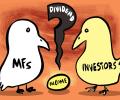
The combined dividend payout by early-bird companies -- those that have declared their results for FY21 -- is up 8.9 per cent, lower than the 21.9 per cent rise in in FY20 but ahead of the underlying growth in India Inc business last year. Combined net sales of these early birds were down 1.8 per cent last financial year while net profit was up 27.3 per cent in FY21. Some top companies that have stepped up dividend payout in FY21 include Hindustan Unilever, Indus Towers, Tata Steel, Ultratech Cement, Larsen & Toubro, Dabur, Asian Paints, and UPL. In contrast, banks have skipped dividends under an RBI diktat while companies such as Marico, TCS, Maruti Suzuki, and Godrej Consumer are paying lower dividends for FY21.
Corporate India has high hopes from the upcoming Budget.

The sale of Essar Oil was India's biggest deleveraging exercise undertaken by any debt-heavy group
India's harsh lockdown has left companies grappling with temporary closure, chaotic supply chains and depressed demand. Consequently, business plans have been modified.

Bankers said the outlook of M&As in India in 2024, especially in the second half after the Lok Sabha election, seems relatively better.

Major Indian automobile companies like Tata Motors, Bajaj Auto and Mahindra & Mahindra seem to have put up a robust performance in Q3 FY 10, paying advance tax of Rs 100 crore (Rs 1 billion), Rs 320 crore (Rs 3.2 billion) and Rs 195 crore (Rs 1.95 billion), respectively.

CEOs have complained that high interest rates have blocked their investment decisions. At the same time, customers are also deferring their purchases for new consumer durables, cars, and homes.

The earnings are, however, expected to be down around 2 per cent on a sequential basis due to pent-up demand getting exhausted and the adverse impact of rising metals and energy prices on consumer goods and manufacturing companies.

Not surprisingly, equity investors are bidding-up stock prices across sectors and the broader market is now more valuable than pre-Covid levels.

India Inc is expected to post 35-45 per cent rise in net profit in the fourth quarter ended March 31.

Indian companies had raised $2.39 billion from foreign markets in May 2015.

While some such as Hindalco, JSW Steel, India Cements, Essar Oil, Tata Steel and Jet Airways have already announced plans to raise a combined Rs 70,000 crore, there are many who are redrawing proposals to enter the market to raise money.

Finance Minister Nirmala Sitharaman on Tuesday unveiled a Rs 39.45 lakh crore Budget with a view to fire up the key engines of the economy to sustain a world-beating recovery from the pandemic. This was Sitharaman's fourth Budget. While the taxpayers were left in the lurch, once again, was she able to cheer Corporate India?

According to the Icra report, earnings before interest, tax, depreciation and amortisation margin of its sample declined by 44 basis points on a YoY basis and 23 basis points on a quarter-on-quarter basis to 16.6 per cent.

On the profitability front, Crisil foresees a 0.5 per cent basis points y-o-y jump in EBITDA (operating profit) margins in Q2 FY15.

The Crisil study covered 600 companies excluding financial services and oil companies, representing 71 per cent of the overall market capitalisation of India Inc.

With the dizzying rise in the number of Covid-19 cases in the country, India Inc has transitioned from a wait-and-watch policy to full-on emergency mode, bringing back remote and flexi work, stringent safety protocols, and allowing only essential travel. Companies - especially in metros like Delhi, Mumbai and Kolkata - that had adopted a hybrid work model during the last few months when the caseload remained low, are either switching back entirely to work-from-home (WFH), or calling skeletal staff to office on select days. Take the case of cigarettes-to-hotels major, ITC, which had been on a hybrid work model over the last few months.

The much-talked-about sale of Ambuja Cement and ACC by Holcim Group will see the single-biggest outflow of foreign capital from the country if the two cement firms are acquired by Indian investors. The deal, valued at nearly $10.35 billion, will put in the shade Cairn Energy Plc's exit from India in 2010, when it sold Cairn India to Vedanta Group for $4.48 billion. According to various reports, big business groups such as AV Birla, JSW Group, and Adani Group are in the fray to acquire Holcim's assets in India.

Most of the Adani Group companies fell in the morning trade on Friday and flagship Adani Enterprises tumbled 10 per cent after index provider MSCI decided to reduce the weightage of four firms in its indices following a review. Amid volatile trading in the market, seven Adani Group firms were in the negative territory while three others were in the green. Adani Enterprises plunged 10 per cent to Rs 1,734.60 per share, its lower price band on the BSE, and the company's market valuation dropped to Rs 2.14 lakh crore.

Brokerages expect revenue growth at a 7-quarter high but profitability may disappoint.

The financial year ending Saturday saw such big-ticket events that set the directional tone for the country's business journey.
Revenues of Indian companies, excluding those engaged in banking and oil, are expected to grow marginally at 5-6 per cent in the first quarter of this fiscal.

Top companies across sectors -- automobile maker Maruti Suzuki, consumer electronics giant Samsung to IT giant Infosys -- have reopened factories and offices as India took its first steps towards resuming economic activity after weeks under a near-total coronavirus lockdown.

Tesla Inc chief Elon Musk is set to acquire micro-blogging site Twitter for about $44 billion. Back home, India Inc, too, is seeing aggressive merger and acquisition (M&A) activity with PVR-Inox and HDFC-HDFC Bank announcing their mergers recently. While Axis Bank recently acquired Citi India's India retail business, reports suggest Larsen & Toubro Infotech (LTI) and Mindtree could be eyeing a merger.
Companies announce Rs 768 bn worth investments in Dec quarter versus Rs 1.15 trn in Sep quarter

Premiumisation, improving demand aid realisation growth at most large firms

Industrialists affirm their belief that the adverse effects of demonetisation and the goods and services tax are finally over.

Suresh Prabhu has announced a slew of measures to improve servcies in trains and railway stations

"India's middle class, small traders and farmers are the lifelines of its economic growth. By catering to these ambitions #Budget2019 infuses hopes for millions of dreams."

A total of Rs 52,759 crore has been raised by 61 companies through initial public offers till October this fiscal, higher than the funds mopped up through this route in the last financial year, the government told the Lok Sabha on Monday. Out of the 61 companies that hit the markets till October of the current fiscal, 34 entities were Small and Medium Enterprises (SMEs). Finance Minister Nirmala Sitharaman said that a large number of manufacturing and service sector companies are coming up for listing.

Hailing Prime Minister Narendra Modi and the Bharatiya Janata Party government, top industry captains pledged mega investments at the Vibrant Gujarat Global Summit
.jpg)
Q1 results indicate more pain ahead, as slowdown has spread to more sectors, pricing power has come down and rising interest cost is eating into profits.

CEOs point fingers at rural job guarantee and related govt welfare schemes; say mechanisation an increasingly viable option.

As Covid-19 cases surge in India, companies have realised it's a tightrope walk between maintaining production and ensuring employee safety.
.jpg)
Net profit grew 25.4% in Q4 but revenue growth, lower at 8.5%, suggests lack of volume expansion.
